
Bobadilla v. Sunshine Flu
On sick and safe time, the sunny day call-out, and why your attendance policy might be working against you.
It's June. The vacation requests are stacking up, the kids are out of school, and someone just called out sick on the first genuinely sunny Friday of the year. If you're a small employer, you know the feeling. The suspicion is immediate. The frustration is real. And somewhere in the back of your mind is the question you're not supposed to ask out loud: are they actually sick or are they starting their weekend a day early?
That question is understandable. It's also largely irrelevant to what you're legally allowed to do about it, and the attendance policies most small employers have in place don't help as much as they think.
Summer is when attendance management goes from background noise to active frustration for founder-led businesses. It's also when the absence of a written policy, or a written policy nobody actually follows, becomes most visible. Before the next sunny Friday lands in your inbox, here's what you need to know.
The Accidental Policy
Most small businesses don't have an attendance policy. They have a ‘practice’. A general understanding that evolved over time based on who asked for what, what the founder said yes to, and what felt reasonable in the moment.
The practice looks fine until it doesn't. The time clock that rounds to the nearest quarter hour on some days and not others. The shift schedule delivered the morning of. The employee who's been five minutes late every day for six months without consequence who suddenly gets written up when the owner is having a bad week. The new hire who gets disciplined for the same behavior the long-term employee does openly.
Inconsistency is the condition that makes enforcement impossible and disputes inevitable, all the while an owner feels like they are doing their employees a solid by being flexible. But an employee who gets written up for being two minutes late after months of five-minute grace periods has a legitimate grievance. Not necessarily a legal one, but one that creates friction, damages trust, and in some situations becomes evidence of disparate treatment when the enforcement pattern doesn't look the same across employees.
A written policy doesn't have to be complicated. It has to be clear and it has to reflect what you'll actually do. More on that in a moment.
The Progressive Discipline Trap
Progressive discipline sounds like a best practice. Verbal warning, written warning, final written warning, termination. It's in a lot of employee handbooks because it sounds thorough and fair.
And then most business owners don't follow it.
Not because they're bad at their jobs or bad people. Because real situations don't always fit a four-step framework, and when you skip from a pattern of absences straight to termination without the intermediate steps, you've violated your own policy. That violation doesn't automatically create legal liability but it hands a departing employee a legitimate argument that the process wasn't followed, which complicates things in ways that are easily preventable.
The fix isn't to become more rigorous about progressive discipline. It's to not put language in your policy that you won't follow consistently. A policy that says something like the company will take appropriate disciplinary action up to and including termination based on the circumstances gives you more flexibility than a four-step ladder you'll skip whenever the situation calls for it.
The most dangerous policy - regardless of what it says - is the one that commits you to a process you won't actually follow.
What Washington State Actually Requires
Washington State requires all private employers regardless of size to provide paid sick leave to employees. This includes full-time, part-time, temporary, and seasonal workers. Independent contractors are not covered.
Employees accrue one hour of paid sick leave for every 40 hours worked, beginning on the first day of employment. There is no cap on annual accrual. Employers can configure a waiting period of up to 90 days before an employee is permitted to use accrued leave. Unused leave of up to 40 hours must carry over to the following year.
Qualifying reasons are broad and include the employee's own illness or medical care, care for a family member, closure of a child's school or place of care, and as of 2025, immigration proceedings involving the employee or a family member.
Employees must give advance notice when the need is foreseeable. For unforeseeable absences, notice must be given as soon as practicable. Employers can require documentation for absences exceeding three consecutive workdays but cannot require the employee to disclose the specific nature of the illness or condition.
Seattle and Tacoma have their own ordinances with requirements that differ from the state baseline. When both apply, the employer follows whichever is more favorable to the employee.
The Jurisdiction Comparison
Here's how the three frameworks stack up:
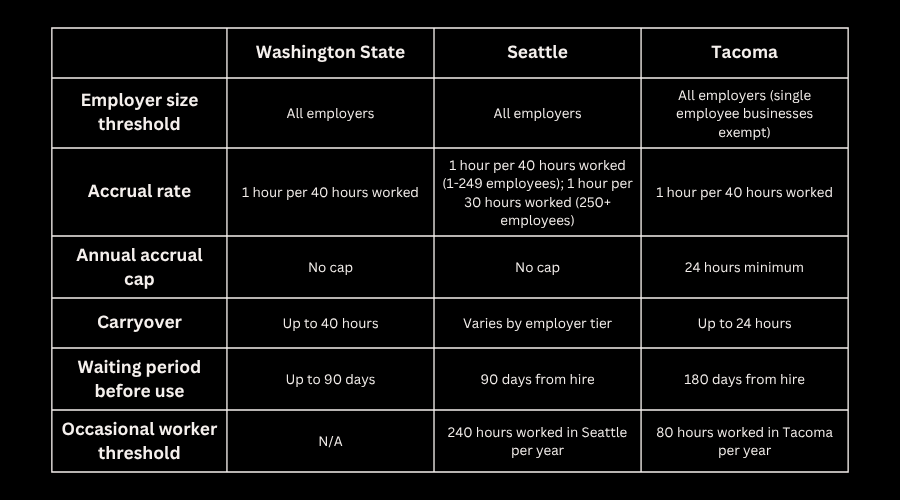
If your employees work in multiple jurisdictions, you may have overlapping obligations. The rule is always whichever requirement is more favorable to the employee.
The Sunny Day Problem
Back to the Friday call-out.
Washington's sick and safe time law is broad by design. Employees don't have to tell you why they're using it beyond confirming it's for a covered reason. You cannot require a doctor's note for absences of three days or fewer. You cannot require the employee to explain the nature of the illness. You cannot discipline an employee for using leave they legally accrued for a legally covered reason.
What you can do is require reasonable advance notice for foreseeable absences and as-soon-as-practicable notice for unforeseeable ones. You can require documentation after three consecutive days. You can enforce your own attendance policies consistently, which is the important word, as long as they don't conflict with the law.
What you cannot do is use sick and safe time usage as a factor in attendance discipline. Pointing to the number of times an employee used sick leave as evidence of an attendance problem is the kind of thing that turns a performance conversation into a retaliation claim.
The frustration with the sunny day call-out is understandable. The legal tools for addressing it are narrower than most employers expect. The better investment is a clear attendance policy that covers what you can actually enforce, communicated to employees before the situation arises rather than after.
What A Good Attendance Policy Actually Looks Like
It doesn't have to be long. A short, clear policy that you'll actually follow is more useful than a comprehensive one you won't.
At minimum a good attendance policy covers how employees are expected to notify the employer of an absence and how much notice is required, what documentation can be requested and when, how tardiness is defined and tracked, and what the consequences are for attendance issues stated in terms that give you flexibility rather than locking you into a specific sequence.
Some employers do well with a simple policy that says the company will comply with all applicable state and local leave laws, that employees are expected to follow the notice requirements in those laws and in any additional requirements the company establishes, and that attendance issues will be addressed through appropriate action up to and including termination based on the facts and circumstances.
That's not avoiding the issue. That's a policy that reflects reality and gives you the flexibility to handle situations as they actually present themselves rather than through a process that assumes every situation is the same.
The policy that works is the one you'll enforce consistently. If you won't follow twelve steps, don't write twelve steps.
If your attendance policy is the kind that lives in a drawer and hasn't been read since you wrote it, or if you don't have one at all and summer is already feeling complicated, it's worth a conversation. Office Hours are available for exactly this kind of question. No retainer required. Come with your situation and leave with a plan.
Get in touch at understoryadvising.com
- m
