
Bobadilla v. The Evergreen Clause
On automatic renewal clauses and the nonsense they can cause for your business when you forget which contract says what.
Automatic renewal language in a B2B agreement, sometimes called an evergreen clause, renews a contract for another term unless a party provides written notice of non-renewal within a timeframe before the renewal date. Most businesses kind of know when contracts are due for renewal, but don't track those notice windows, so they end up regularly committing to another year of service, software, or supply relationships they didn't consciously choose to continue.
Here's the coolest thing about evergreen clauses: they're not hidden. They’re right there for reading in the contract. They're in the term and termination section of almost every vendor agreement, SaaS subscription, and supplier contract you've signed. They're standard. They're legal. And they work exactly as written – which can be great when you’re looking to avoid service disruptions and renegotiation of a good contract, but problematic the rest of the time.
Really, the problem isn't the clause. It's that a contract is usually the most well read around the time it’s signed (if at all), and then it falls to the wayside. That notice deadline isn’t relevant until some arbitrary later time, and most businesses don't have a system for tracking contract renewal windows. A contract signed in October with a 60-day non-renewal notice requirement has a deadline in August of the following year, which means you need to start thinking about it in July – June if you want to renegotiate with the option to walk away (hint: you probably do). If you wait until fall to think about it, by the time you realize the relationship isn't working, you're already inside the window and committed to another twelve months, or trying to negotiate on commercial goodwill alone.
What does an automatic renewal clause say?
They vary in length and formality, but most evergreen clauses include the same essential elements: an initial term, a renewal mechanism, and a notice window. Here's what to look for:
The initial term establishes how long the agreement runs from the effective date. Most often one, two, or three years. Some software agreements use annual terms. High-value or specialized supplier agreements often use longer periods.
The renewal mechanism states whether renewal is automatic or requires action on someone’s part. In an evergreen clause, renewal is automatic. Neither party needs to do anything for the contract to continue. It rolls over by default unless someone acts to prevent it.
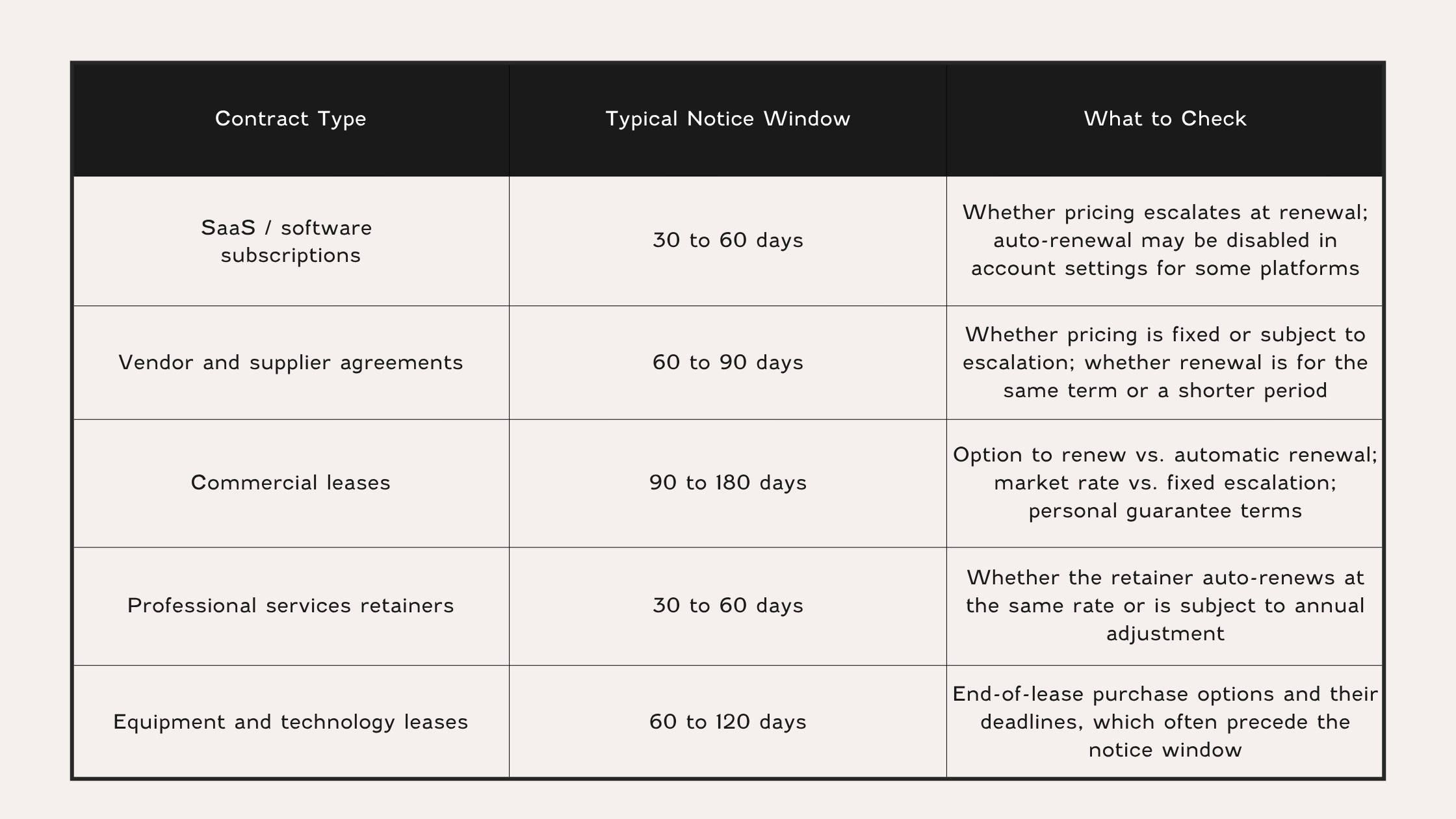
The notice window specifies how far in advance of the renewal date you (or they) need to provide written notice of non-renewal. This number matters most and is easiest to miss. Common windows range from 30 to 90 days, though some agreements push out to 120 or even 180 days. Software contracts are often shorter. Commercial supply agreements and leases tend to be longer.
Some evergreen clauses also include automatic price adjustments at renewal. The agreement might specify that pricing escalates by a fixed percentage or by a relevant index at each renewal. If you've been on the same rate for two or three years and the agreement has an escalation clause you've never tracked intentionally, that change may have been happening without you noticing.
Why do businesses miss the notice deadline?
Because running a business is bonkers. And several other reasons, more structural than careless.
The agreement was signed and filed. Contracts get signed, countersigned, and put away. The operational relationship takes over. The contract exists somewhere, but nobody is tracking the renewal date against a calendar.
The deadline arrives before the problem does. Most vendor relationships work reasonably well at the beginning. The problems that make a business want to exit often emerge over time, and by the time they're visible enough to act on, the notice window has already passed.
The notice window is buried. Evergreen provisions often appear in the middle of a dense term and termination section that reads like boilerplate. The 60-day notice requirement is three sentences from the end of a paragraph. Most people reading the contract the first time are focused on price, scope, and deliverables. The renewal mechanics get skimmed.
Nobody owns the calendar. In small businesses, contract management often belongs to whoever signed the agreement. That person may have changed roles, left the company, or simply never created a reminder. There's no central system for tracking renewal dates, and the vendor certainly isn't going to remind you when the window opens.
What are your options after you've missed the window?
The honest answer is that your options narrow significantly once you're inside the notice window or past it. But they're not zero.
Negotiate anyway. The notice window is a contractual right, not an absolute obligation. If you've missed it but the vendor knows the relationship isn't working, there may be room to negotiate an early exit or new service level agreements. Particularly if the vendor has another customer waiting for the capacity, or if the relationship has been genuinely difficult for them too, a mutual agreement to terminate early is sometimes achievable. It's worth asking before assuming you're stuck.
Review the termination for cause provisions. Even if you can't exit for convenience, most contracts allow termination for cause if the other party has materially breached the agreement. If performance has been consistently deficient, deliverables have been missed, or the vendor has failed to meet the service levels specified in the agreement, a termination for cause may be available. That requires documentation of the breach and proper notice under the agreement.
Check the assignment and change of control provisions. If your business is in transition, an acquisition, a merger, or a significant restructuring, many contracts have assignment restrictions or change of control termination rights that create an opportunity to exit agreements that would otherwise run to term.
Accept the renewal and use the time productively. If none of the above apply, you may be committed to another term. That's not great, but it's an opportunity to document the issues, establish the performance record that supports a termination for cause if things don't improve, and build a proper exit plan so you're not in the same position twelve months from now.
How do you stop this from happening again?
First things first. If you didn’t get a notice within the window this time, you already might be in the window for next term. Take advantage and send notice now.
The long term fix is a contract calendar, and it doesn't have to be complicated. The goal is a single place where every active agreement has its renewal date and notice deadline visible, with a reminder that fires at least 30 days before the notice window closes.
When you sign a new agreement, find the term and termination section. Note the initial term end date. Calculate the notice deadline by subtracting the notice window from the renewal date. Put both dates in the calendar with reminders. That takes about ten minutes per contract and eliminates the problem entirely.
For agreements that are already in place and not being tracked, Q4 is the right time to audit. Pull your active vendor agreements, supplier contracts, and software subscriptions. For each one, find the renewal date and the notice window. Build the calendar forward. If any deadlines are approaching in the next 90 days, that's the first action item.
An evergreen clause alone isn't a problem. It's a standard contractual mechanism that exists for legitimate reasons: it gives both parties continuity without having to renegotiate every year unless something has changed. The problem is treating it as invisible until it's relevant. By then, it's usually past the point where you have a choice.
- m
If you'd rather read about contract traps here than find them in your vendor agreements at 11pm, subscribe below.
