
Bobadilla v. The Non-Compete Ban
When Washington's near-total ban on non-compete agreements takes effect, what it covers, and what Pierce County employers need to do before the clock runs out.
Washington Governor Bob Ferguson signed HB 1155 into law on March 23, 2026, banning virtually all non-compete agreements for Washington employees and independent contractors effective June 30, 2027. The ban applies retroactively, which means agreements already in place become void on that date regardless of when they were signed.
If you have a non-compete in any employment agreement, contractor agreement, or offer letter, you have less than nine months to figure out what replaces it.
This isn't a continuation of the 2020 restrictions on non-competes. That law limited them. This one eliminates them. Those are different problems requiring different responses, and the 2027 deadline is not as far away as it sounds.
When does Washington's non-compete ban take effect?
June 30, 2027. That's the effective date of HB 1155. On that date, all non-compete agreements with Washington-based employees and independent contractors become void and unenforceable, regardless of when they were signed. An agreement from 2019, 2022, or last month is treated the same way.
The retroactive application is the part that catches most employers off guard. You don't need to have signed anything after March 2026 to be affected. If you have a non-compete in an active agreement right now, that agreement becomes unenforceable in 2027 whether you do anything or not.
There is one narrow carve-out: any lawsuit filed before June 30, 2027 to enforce an existing non-compete can proceed under the current law. After that date, no new enforcement actions are permitted.
What counts as a non-compete under the new law?
More than you might expect. The law defines non-competition covenants broadly to include any covenant, agreement, or contract that prohibits or restrains an employee or contractor from engaging in a lawful profession, trade, or business of any kind.
That broad definition also sweeps in two categories that employers don't always think of as non-competes:
Training repayment agreements (sometimes called TRAPs) that require an employee to repay training costs if they leave to compete against the employer.
Clawback provisions and forfeiture clauses that condition the employee's right to keep bonuses, commissions, or equity on not competing after departure.
If you've been using any of those structures to achieve the same result as a non-compete, those provisions are also void as of June 30, 2027.
What are the exceptions?
The ban has two narrow exceptions. Everything else is prohibited.
Sale of business. Non-competes entered into in connection with the sale of a business, or the acquisition or disposition of at least a one percent ownership interest, remain enforceable. The rationale is that a buyer of a business has a legitimate interest in ensuring the seller doesn't immediately open a competing operation down the street.
Franchise agreements. Non-competes entered into by a franchisee in connection with a franchise sale that complies with Washington's franchise statutes remain enforceable.
That's it. No income threshold exception. No executive exception. No high-earner carve-out. Washington's 2020 law allowed non-competes for employees earning above a threshold (currently around $128,000). That threshold disappears on June 30, 2027.
What happens to non-solicitation agreements?
They survive, but with new limits.
Non-solicitation agreements are not banned under HB 1155. Two types remain permissible:
Employee non-solicitation agreements, which prohibit a departing employee from recruiting their former colleagues to leave the employer. These are not time-limited under the new law.
Customer non-solicitation agreements, which prohibit a departing employee from soliciting customers, patients, or clients with whom they had a direct relationship through their work. These are now capped at 18 months after the end of employment.
One critical limitation on customer non-solicitation: any provision that prohibits an employee from accepting business from a former customer, even if the employee didn't solicit it, is treated as a prohibited non-compete, not a permissible non-solicitation. The distinction matters. You can prohibit them from going after your clients. You can't prohibit them from serving a client who comes to them.
What do Washington employers need to do before the deadline?
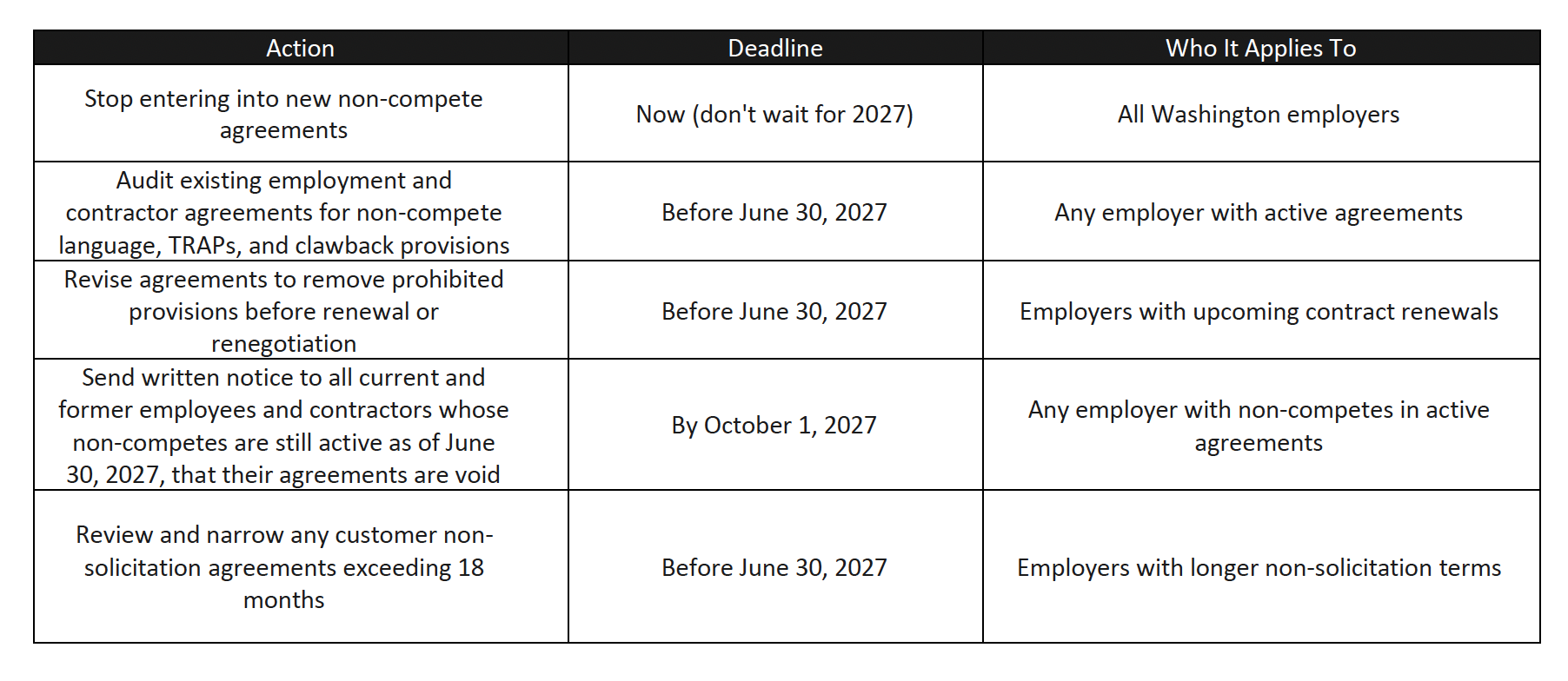
What are the penalties for non-compliance?
If an employer violates the law by entering into, enforcing, or even claiming that a worker is subject to a void non-compete, the employer is liable for the greater of the worker's actual damages or a statutory penalty of $5,000, plus the employee's attorney's fees, costs, and expenses.
The $5,000 statutory penalty applies per violation. An employer with fifteen former employees subject to non-competes who sends no notice and continues to imply those agreements are enforceable is looking at potential exposure of $75,000 in statutory penalties before any actual damages are calculated.
Enforcement can be brought either by the attorney general or by the individual employee or contractor.
What should replace a non-compete?
Confidentiality agreements and narrowly tailored non-solicitation agreements remain the primary tools for protecting legitimate business interests after June 30, 2027. Those tools work differently than a non-compete, and they require different drafting.
A well-drafted confidentiality agreement protects your proprietary information, your pricing, your client strategies, and your trade secrets without restricting where a departing employee can work. A customer non-solicitation agreement prevents them from going after your clients directly, for up to 18 months, without preventing them from serving clients who come to them.
If your current non-competes are doing something those tools can't do, that's a more specific conversation worth having before 2027, not after.
- m
If this is the kind of thing you want to know before it becomes urgent, the blog covers Washington State employment and business law in plain language. Subscribe below and it comes to your inbox.
