
Bobadilla v. The ‘Old’ Contract
Five agreements every Tacoma area business owner should pull out and re-read before December 31
Most businesses have agreements that were signed once, filed in an email, or folder, or filing cabinet somewhere, and never looked at again. Before December 31, there are five categories of contracts worth pulling out, reading as they exist today, and deciding whether they still reflect the relationship they're supposed to govern.
Q4 has a way of surfacing contract problems that spent the rest of the year quietly accumulating. A client relationship that drifted from the original scope. A vendor agreement that auto-renewed into another year of unused subscription fees before anyone noticed. A price that made sense eighteen months ago and doesn't anymore. The contract didn't cause any of these things. But the contract is usually where the conversation about fixing them starts, and starting that conversation in October is a different experience than starting it in January when you’re already locked in.
Here are five types of agreements worth reviewing before the end of the year, and what to look for in each.
1. Your client-facing commercial terms: does the scope still match what you're doing?
Scope creep is one of the most consistent sources of contract friction in service businesses. It happens when work evolves, as it usually does, but the written agreement stays fixed to what was true at the start of the relationship. Over time, the gap between the contract and the day-to-day expectations becomes something both parties are managing around rather than addressing directly.
Pull your active client agreements and read the scope of work section. Does it describe what you're doing today or what you were delivering when it was signed? If the work has expanded, or even shape-shifted in some other way, the contract likely doesn't capture the additional risk and obligations you've taken on or the additional revenue you should be receiving for them. On the flip side, the contract may be promising things you're no longer doing.
A scope that doesn't match the actual work is a documentation problem. And documentation problems are legal problems. In Washington State, the written agreement is the primary evidence of what the parties agreed to. If a dispute arises over what you were supposed to deliver, you're likely working with whatever the document says, not whatever you both understood informally.
Q4 is a natural time to have the update conversation with a client because it frames as planning for the year ahead rather than flagging a problem with the year behind. A short addendum or a new statement of work is usually all that's needed.
2. Vendor & supplier agreements: are you in a recurring contract you didn't plan for?
Automatic renewal clauses, sometimes called evergreen provisions, are industry standard in vendor software agreements, subscription services, and supplier contracts. They're written to renew the agreement for another term automatically unless one party provides written notice by a specified deadline, often 30 to 90 days before the renewal date.
Most businesses miss these deadlines. Not because they decided to renew, but because nobody was tracking the notice window and the renewal happened by default.
Pull your vendor and supplier agreements and look for the term and termination section. Note every automatic renewal provision and the notice deadline attached to it. If any of those deadlines fall in December or January, you need to know now whether you want to renew. If you don't want to renew, the notice needs to go out before the deadline. If you do want to renew, you can relax, but you should still be tracking it so the decision is intentional rather than accidental.
Relatedly, that contract may carry a pricing issue. Many vendor agreements allow the vendor to adjust pricing at renewal with notice. If you've been on the same rate for two or three years, there may be a price increase coming that's buried in the renewal terms, invoice note, or a statement supplement you've never looked at.
3. Independent contractor agreements: do they reflect the current relationship?
Washington State applies an aggressive test for worker classification, and the consequences of misclassification are distracting at best, and destructive at worst. L&I audits, back taxes, penalties, and potential benefits obligations don't require a lawsuit to arrive. They can result from a routine audit or a complaint.
The written agreement between you and a contractor is one piece of the classification analysis, but it isn't the whole picture. What matters most is the actual relationship: who controls how the work is done, whether the contractor works exclusively for you, whether they have their own business infrastructure, and whether the work is central to your business operations.
In unsurprising news, an independent contractor agreement that describes a relationship that doesn't exist anymore creates its own problems. If your contractor has been working exclusively for you for two years, is on your schedule, uses your tools, and takes daily direction from you, the agreement shouldn't still describe a project-based relationship with a defined end date and deliverables.
Pull your active IC agreements. Read the scope, the term, and the control provisions. Consider whether the written relationship still matches the real relationship. If it doesn't, the fourth quarter is a reasonable time to update the agreement before the new year resets the clock on the relationship.
4. Your client-facing legal terms: do they protect you from what you've learned this year?
Most service businesses use a standard agreement template that was drafted or downloaded at some point and hasn't been substantially updated since. Every year of operating your business teaches you something about what the agreement should have said.
A few specific things worth checking before December 31:
• Limitation of liability. Does your agreement cap your maximum financial exposure to the client? A limitation of liability clause that restricts damages to the amount paid under the contract is standard in service agreements and one of the most protective provisions you have. If it's missing or insufficiently narrow, that's worth fixing before the new year.
• Payment and late payment terms. Does your agreement specify when payment is due, what constitutes late payment, and what happens when a client doesn't pay on time? Interest charges, collection cost-shifting, and suspension of services provisions are all enforceable in Washington State if they're in the agreement. If they're not in the agreement, your options when a client doesn't pay are more limited than they need to be.
• Termination for convenience. Does the agreement give you a clean way out of a client relationship that isn't working? A termination for convenience clause with reasonable notice allows you to end the relationship professionally without needing to prove breach. Without one, ending a client relationship before the natural end of the agreement can be complicated. This is also a great time to reflect on whether you’re wanting to use that route with any current clients as you move into 2027.
• Dispute resolution and venue. Does your agreement specify that disputes will be resolved in Pierce County or Washington State? For a Tacoma-area business, having your disputes handled in the jurisdiction where you operate is a meaningful and practical protection. Traveling to defend a dispute in another state, or under another state's law, is expensive and inconvenient in ways that are entirely avoidable with a venue clause.
5. Your commercial lease: when does it expire and what are your options?
Commercial leases in the Tacoma and Pierce County area are typically three to five years with options to renew. The option to renew is usually subject to notice requirements, often 90 to 180 days before the lease expiration date. Miss that window and you may lose the option, or you may find yourself negotiating a renewal from a weaker position because the landlord knows you're not prepared to relocate.
If your lease expires in 2027 or early 2028, the notice window may be approaching. Pull your lease, find the expiration date and the renewal option section, and note when notice is required. If you want to renew, start that conversation with your landlord now, while there's room to negotiate and before the deadline makes the conversation urgent.
Also worth checking: does your lease have a personal guarantee? If so, what are the terms and is it still in effect? Does it have a rent escalation clause? If rents have changed significantly since you signed, understanding where your lease stands relative to market may affect whether renewal is the right move.
The quick version: five things to look for before December 31
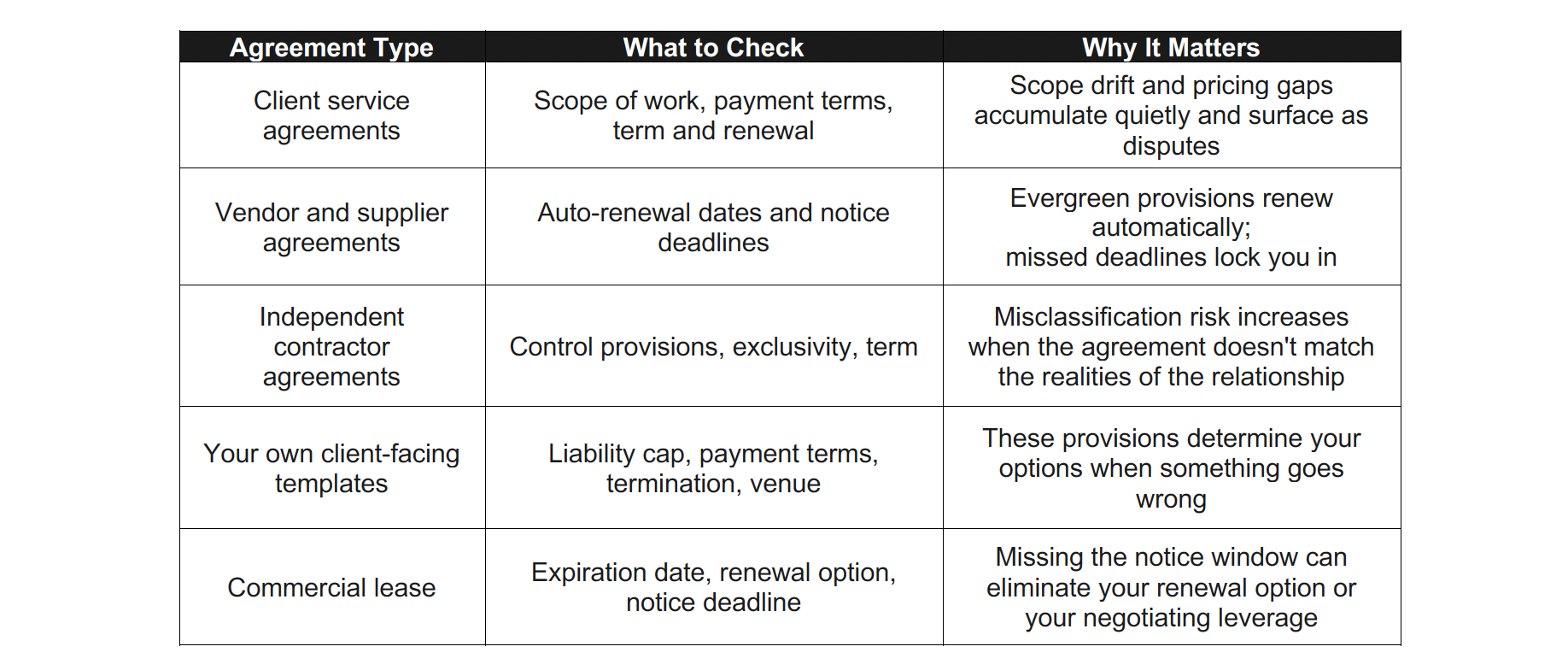
None of this requires litigation or a full legal review to start. Pull the agreements, read the sections identified above, and flag what needs attention. If you find something that needs to be updated, addressed, or documented differently, that's a useful thing to know in October rather than in January when the other party has already acted on the old terms.
- m
If this is the kind of thing you want to catch before it costs you, the blog covers Washington State business law in plain language. Subscribe below and it comes to your inbox.
